
These are the two charts from my video on zone 2: the training zones I coach with, and why the anaerobic threshold is not a fixed 4 mmol. Both are free to download and free to share with credit to aramtraining.
My 11 training zones, Reg to HIT
Zone 2, as it is usually defined, covers anything from 30 to 80 % of your VO2 max. That is not a zone, it is a broad band. So I split it up. My athletes train in 11 zones, from Reg (recovery pace) to HIT (maximum speed), and what is usually called steady state is three zones on its own: low, middle and upper base.
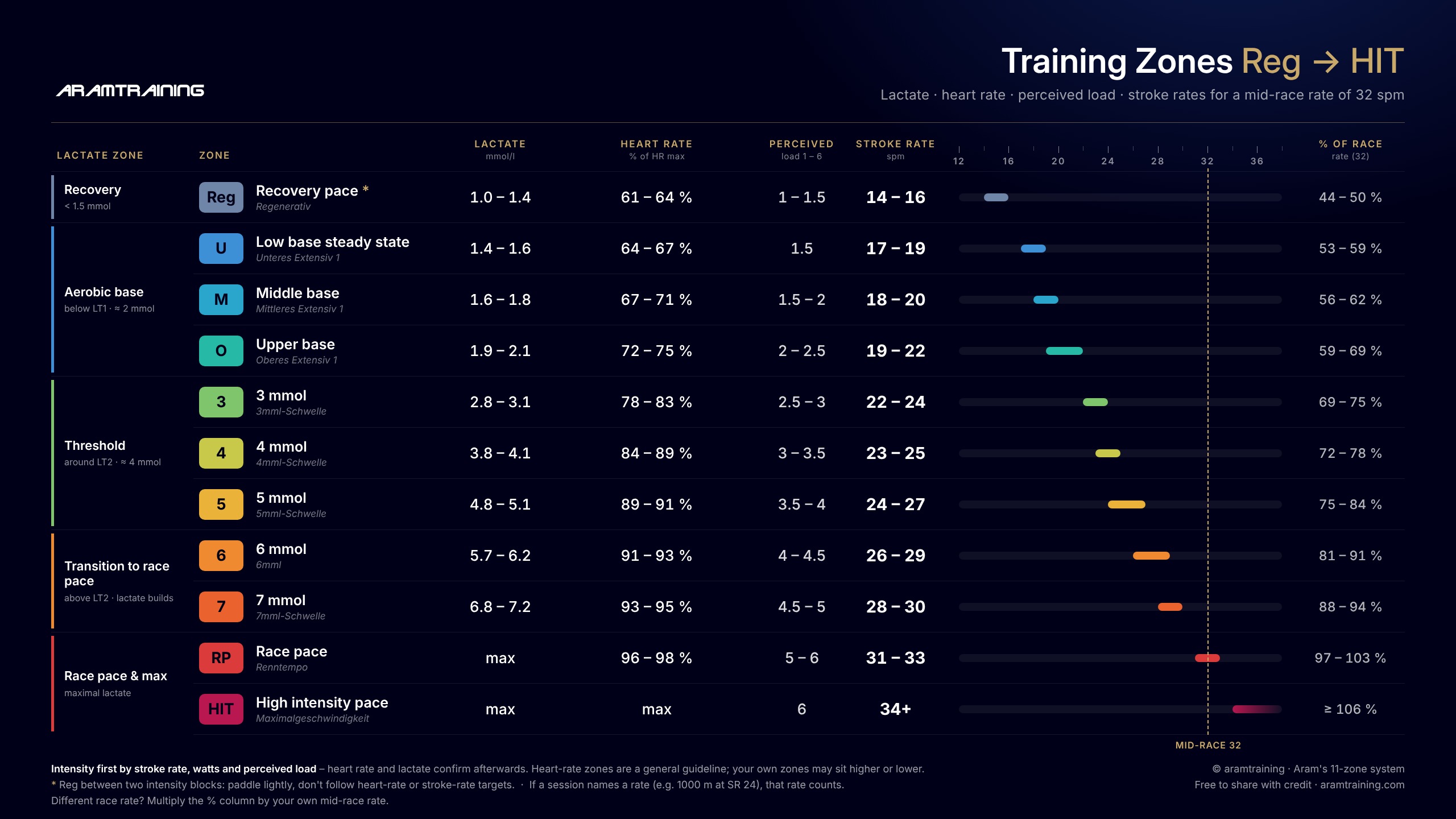
Download the zones table (JPG)
How to read it:
- Gauge intensity by stroke rate, watts and perceived load first. Heart rate and lactate confirm it afterwards.
- Perceived load runs on a scale from 1 (a walk in the park) to 6 (you do not know how to take the next ten strokes), in steps of 0.5.
- Do you race at a different rate? Multiply the percentage column by your own mid-race stroke rate.
- The heart rate zones are a general guideline. Your own zones may sit higher or lower.
- Reg between two intensity blocks means paddling lightly. No heart rate or stroke rate targets.
The anaerobic threshold is not 4 mmol
4 mmol is a statistical average. Your own threshold is probably somewhere between 3.5 and 7 mmol, and it moves from day to day. That is the reason I work with zones at 3, 4, 5, 6 and 7 mmol instead of one fixed line.
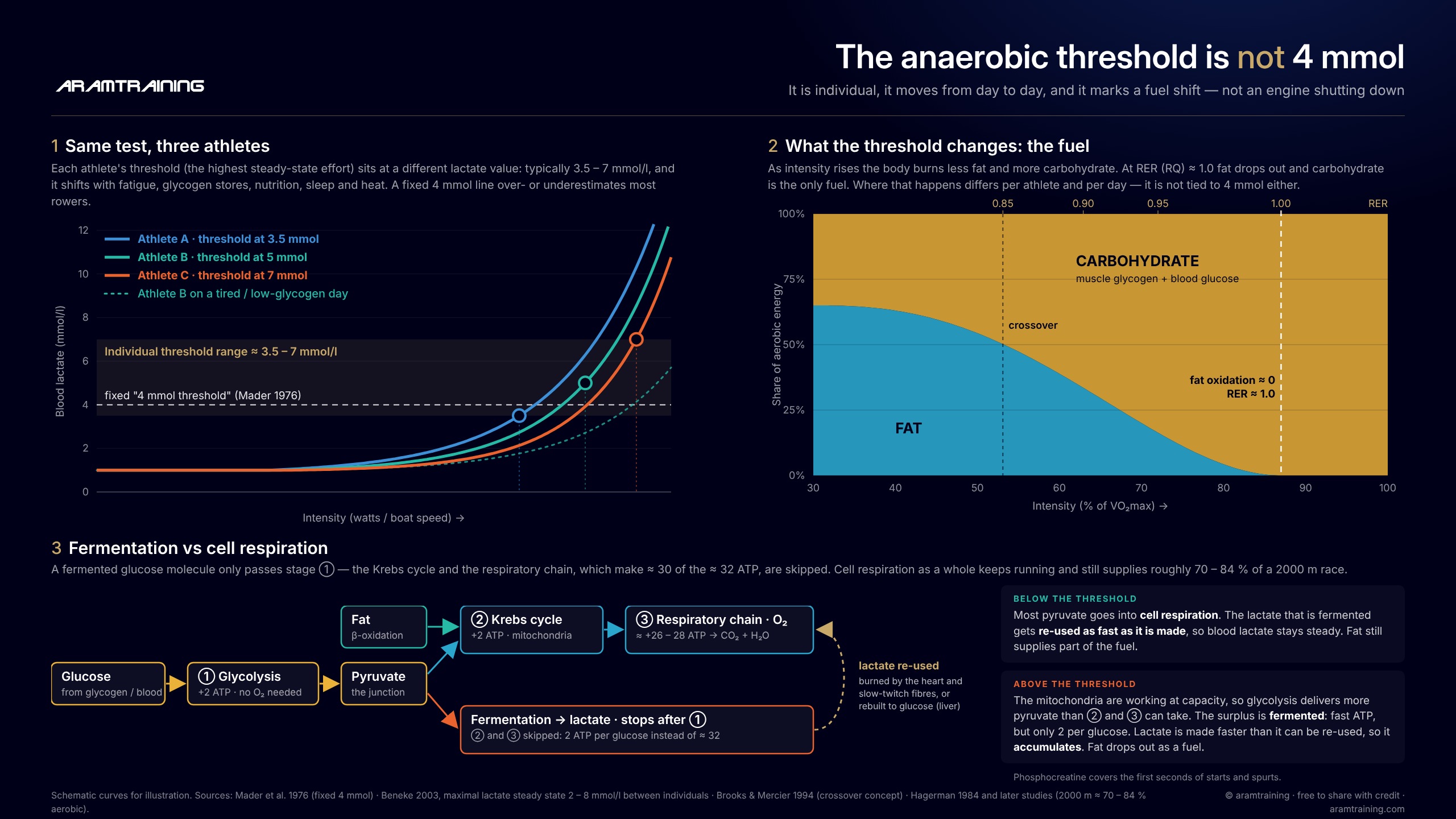
Download the threshold chart (JPG)
The video behind the charts
In the video I go through the three gears, the classic heart rate mistake, why a simple 1 to 6 scale tells me more than HRV, and why 45 to 60 well-structured minutes can give you a similar benefit to the 90-minute erg.

Want me to structure it for you?
The charts show the system. A program puts it into your week, at your level, around your races. The program finder shows which one fits you.
Free to share with credit: aramtraining.com